Friday, 1 April 2011

Hooray for trusting in the cross

Friends, hear these brilliant words, which my soul also needs to hear.

In the run-up to this passage John Stott has been talking about wrong ways to approach hard times and God, by self-accusing, self-pitying or self-asserting. But then he starts talking about the best way of all – to see Him afresh spiritually, and trust in Him:

If it was reasonable for Job to trust in the God whose wisdom and power have been revealed in creation, how much more reasonable is it for us to trust the God whose love and justice have been revealed in the cross? The reasonableness of trust lies in the known trustworthiness of its object. And no one is more trustworthy than the God of the cross. The cross does not solve the problem of suffering, but it gives us the right perspective from which to view it.

We need to learn to climb the hill called Calvary and from that vantage point to survey all life’s tragedies. Since God has demonstrated his holy love in a historical event (the cross), no other historical event (whether personal or global) can override or disprove it. 
from Through the Bible Through the Year, p.88

Praise God for the truth of these words!

Thursday, 24 March 2011

New Word Alive is nearly here.....

On a completely different subject, how shall I blog about New Word Alive this year? I don't think I will be blogging there (although I could tweet there), but I will update this site when I get back.

I've previously tried video interviews - shall I do more of these, and see if I can catch one of the speakers/some of the punters? Shall I try something creative and new? What do you want to hear about? I can't promise too much, but let me know!

Specifically what would you ask the speakers? It looks as though we have prominent Nigerian, English and Australians speaking this year. And of course it's always good to pick the brains of someone as God-happy as Mike Reeves (UCCF theology guy), who'll be there as usual.

Looking forward to seeing you there, if you are planning to go!

Tuesday, 22 March 2011

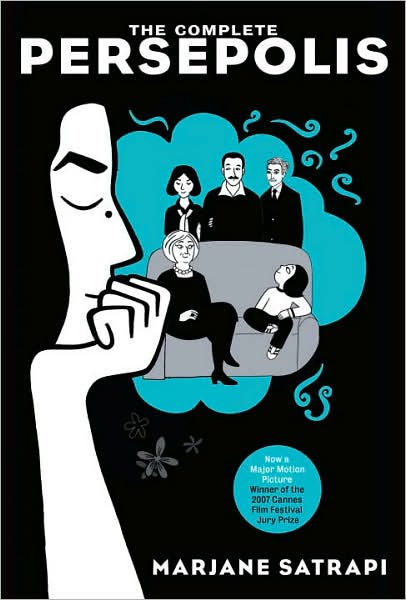
Graphic novel review: Persepolis I

A couple of months ago I had the chance to read part one of “Persepolis” an autobiographical tale of Marjane Satrapi growing up in Iran as a girl and a young teenager. It's worth a read, as we consider the price of freedom for the Libyans and others in the Middle East. Marjane's unique upbringing was a strange learning experience for a young girl and she clearly has many lively memories of her parents talking enthusiastically of “revolution” late into the night, and taking an active part in protests in the late 1970s. The true story is portrayed in this graphic novel with a style that exudes charm and manages to capture through stark black and white pictures some of the emotions of frustration, resolute fervour and desperate loss.

I’m not good with the facts of history, but I love details that bring home what was happening. Marjane remembers what she was doing the day the neighbouring family’s house was bombed during the war with Iraq which began in 1980. She tells how she rushed home fearing the worst, and managed to glimpse a painful sign that her neighbours had been buried when the house came down. It’s moving to think of this really happening to such an ordinary family.

Interestingly we are also introduced to those figures Marjane looked up to as a girl, some imprisoned for many years because of their outspoken views and the longings of people of shrewd minds and hospitable natures as they longed for an end to political injustice. Others with less courage or less wisdom are shown to be inconsistent in their views, and stirred up by a crowd – we get a realistic view of human nature here.

As Marjane tries to comprehend things like the torture of Communists and the changing regimes, she aspires to be a revolutionary herself and imagines herself debating these things with both God and Karl Marx in some light-hearted dream-like sections. Ultimately she feels that the big-bearded God of her dreams is no use to her cause, or perhaps he is supposed to be impotent in her view, an imaginary being made up by children. Either way, she moves on from him fairly quickly.*

She also shows us what it was like to grow up as a child in those times, and the fun and hurt caused between classmates as they discussed or acted out their parent’s differences (somewhat like the children in The Book Thief). The influence of the West on Satrapi is evident, leading her to rebel – although maybe this was more to do with her sharp mind and sense of passionate outrage at what was happening. One amusing section tells of how she was caught by local women wearing a Michael Jackson badge she’d acquired from the black market, and how she lied that the badge showed Malcolm X (MJ was still black then), an important “historical figure” – and they believed her! Another time her parents managed to bring back some trendy posters from (I think) Turkey, by sewing them into the back of a coat.

The obvious love in the family also shines through as they seek to bring up their girl as best they can – eventually sending her away from the country, which as you will have gathered was going through some worrying changes. The glimpse we get here is not only a good mix of the optimism of childhood and the down-to-earth facts of what was happening, it is also a refreshingly individual personal history, where the price of living for one’s conscience and against the current regime is clear.

-----
* As an aside, I hope the way I live and work and stand for causes and pray and trust in God has the opposite effect – that people do not dismiss him as unnecessary, but see the true God of reality as the means by which it is possible to fully and rightly and passionately engage with all the rest of life. 

Click here to find a list of more graphic novels/comics I recommend.

Saturday, 12 March 2011

Graphic novel review: Usagi Hojimbo ("rabbit samurai") vol 1

It’s rare to find a series of stories which manages to capture your imagination, stories that seem fresh even while working within a genre that has definite traditions, stories whose range of characters show a breadth and colour that seems to cover several levels of society. I’m happy to say that this first collection of stories about the lone wandering samurai called Miyamoto Usagi pulls off these feats with a certain irresistible charm.

OK, so the samurai Usagi is drawn as a rabbit, and there are plenty of other creatures around – but this is isn’t a jokey book and fight-scenes are action-packed and deadly. The stories in the first volume "Ronin" are interesting in their variety, from epic quests as Usagi defends the vulnerable people he meets on the road, to a memorable couple of encounters with a mercenary (a rhino) and less-content packed tales of Usagi meeting people, for instance when he is attacked by a brash and arrogant gang at a local place to eat and drink. (Amusingly, Usagi calmly finishes eating his meal while the intruders have turn everything upside-down except his table. When they insult him personally, he takes this as his cue to show them a lesson. Can’t fault his manners, I suppose.)

We come to understand the precarious nature of local politics in the 17th century Japan setting, as Usagi comes across outcast governors and one nefarious villain (cue cackling). One beautifully-formed story shows Usagi making a pilgrimage to his home town – and it shows us how we can still be attached to something or someone we thought we’d left behind. The author deserves credit for including sneaky moles in this tale as well whose deadly ninja training means they can appear out of nowhere by burying through the earth in huge numbers. The series usually has quite a serious and reflective tone, but the “ninja moles” show that author/artist Stan Akai can have some fun!

Finally, the art is quite detailed, showing some influence of Japanese manga, films and history. This Eisner-award winning series which has now been going since 1987 has drawn attention internationally and Empire magazine has named Usagi as the thirty-first greatest comic book character (see the list here) - it’s not hard to see why.

Click here to find a list of graphic novels/comics I recommend - or check back next week for my thoughts on an autobiographical graphic novel about Iran which was published in France - intriguing, no?

Friday, 25 February 2011

Excellent poems from Simon Armitage

If you like poetry, here's treat - Simon Armitage at his most awfully sad and moving and then following this - in a more inventive and funny mode, touching on huge subjects of 20th/21st century life (I prefer the latter one).

Tuesday, 22 February 2011

Book Review: Real Lives in North Korea - nothing to envy

Since interning at Granta Books last year I’ve been enjoying articles and books that bring across the story of how people are living in tough places. One such book is Nothing to Envy: Real Lives in North Korea – which won the BBC Samuel Johnson Prize for Non-Fiction 2010 and which I highly recommend.
Based on accounts of those who managed to escape North Korea, the book gives a sense of what it was like living during different stages of the rigidly controlled Communist regime which continues there to this day. It is incredible to read how fully indoctrinated people were (and I guess, still are) into at times ludicrously harsh or downright unhealthy rules and routines, and the “informing” culture, believed to be essential to “North Korean security”, as well as the personality cult around the leader Kim Il-sung, which had men and women finding their worth in the leader more than in any other relationship. It’s revealing to read about the impact of Kim Il-sung’s death on different groups of people – a patriotic house-wife, broken by the news, whose husband descends into deep depression, a teacher from a lower-class background, a student struggling to bear the weight of the mourning which was expected of him.

This is a well-written history of the last 2 decades, as much as the author, a reporter based in South Korea, has been able to find out, containing surprising detail of the way people saw the world outside through a veil of widely accepted lies, as well as how they saw each other and how they provided for each other in tougher times.

Particularly touching in the midst of all the carefully recorded information about rations and hardworking routines is the story of a young couple, Mi-ran and Jun-sung, secretly visiting each other at night to go walking and talk. A complex and highly restrictive class system prevented them meeting in daylight. It’s revealing and rather sad that despite these episodes one fled the country without trusting the secret to the other.

Another moving episode tells of how Mi-ran, at this point a teacher, watches her children coming to classes exhausted due to starvation in the famine which lasted for many long years in the nineties there. As she notes the missing pupils in her class, she sees her favourite pupil stops coming in and she presumes this is because the child is now dead.

In fact some of the details here and about the hospital in the province made me so sad I stopped reading this book for a while. When I returned, my outrage only increased as I learned of a 16-year-old whose home was taken by other occupants when his father became a beggar, and who was caught trading across the border for food and tortured and imprisoned along with adult inmates! The details here reveal a world of injustice, courage and despair, and above all left me feeling: something must be done.

If like me you feel this way – find out more. Today I was reading a shocking magazine from Release International which talks about the problems facing Christians in North Korea. When it is discovered there is a Christian or a Bible in a household, it’s not unknown for the whole family to be taken to away to brutal labour camps. One man who was in a camp for 5 years tells of how he was treated, at one point tortured by being made to sit on burning coals. Even fleeing North Korea can cause new problems as you are then illegal members of China. Escaping women particularly are preyed on and sold into prostitution and trafficked illegally – your heart just breaks to hear of things like this.

Release International are just at the beginning of their campaign to call for justice and release for imprisoned Christians in the country. Sadly there isn’t that much to read on their website yet – but you can sign their petition at this link. Do it! And do more than this. Find some way of telling someone who could make a difference. Ask leaders. Ask God. Seek more for the people there.

Painting - finished

So this post is waaaay overdue as I finished this painting without much trouble in December. But anyway, finally here it is - so what do you think? It's ok I think, considering I haven't painted for a while. Keep tuned for more creative stuff later this year, once I've settled into my new job a bit.

Wednesday, 26 January 2011

Ode to a stranger

The story behind the following poem is that it is based on a wierd picture that I don't know the back-story to. Up until my recent move I'd been going to a writer's group in Gosport, and group organisers Jo and Marie brought some pictures to inspire us in the month ahead. The one I picked is below, photographed on my phone. I just don't know what to make of it. The poem came out of this idea of perception without understanding.


Here lie I
Dead as a dormouse.

There is the angle of the wall,
The bench,
The way the ground falls away,
And a ragged line of people.

There is a lunchbox,
Limp arms,
A lime green handbag hanging
With its half-sunken mobile phone.

While I lie
The wooden slats form a rim
Of each story’s edge,
Tall tower blocks framing me
From the eagle’s eye

And in my eyes
Life does not eke out
Or brim up or linger.
It is too late to be sorry.
Tilt your wings;
Fly on.


© Richard Townrow

Saturday, 22 January 2011

Persecution and breakfast

After a week of taking in lots of information from various staff at my new workplace, I spent part of the morning lying in, finally getting to making a lazy man’s breakfast, mainly involving toast – and picked up the Open Doors magazine I was sent recently. I was quickly struck by the gap between my relaxed Saturday morning existence and the people who are living in danger and difficulty because of their faith in Christ and the political or societal situations around them, so I thought I’d share some details.

For instance, a Pakistani Christian woman is the first woman in the country to be sentenced to death for a charge of “blasphemy” – an observer says this verdict was given under pressure from a “mob outside the courtroom”. Outrageously, the woman, Asia Bibi, held in isolation since June 2009, and her family, who are in hiding, are in danger for their lives from hard-line Islamic groups, who want to take the law into their own hands.

Another article talks about some young boys in Orisso, India, who Open Doors have provided beds for at Ladruma Boys Home. Many of these abandoned children are traumatised from anti-Christian violence in the area in 2008, when the home became a target – during which time the caregivers were taken away because of the danger! So different to the UK where a lack of sufficient care for vulnerable kids will rightly cause an uproar.

What conditions to be trying to live in, to be trying to learn in or grow in or form relationships or work and earn a living. What a poor situation many fellow believers are in!


I need to grasp just how much opposition to Jesus and his people is out there in the world, and recognise that some people are paying a high price to be identified with the Lord Jesus – because they know what a privilege they have to know Him.

If you do, how do you remember to read about and pray for less fortunate people?

Wednesday, 12 January 2011

Time machines are not the answer

In this sad and telling passage from the quirky novel How to Live Safely in a Science Fictional Universe we hear how Charles sees his position living inside a time machine as living “at the origin, at zero, neither present nor absent, a denial of self- and creature-hood to an arbitrarily small epsilon-delta limit.”

Then we get this interesting passage as to why Charles’ missing father created the time machine to have this function:

“Can you live your whole life at zero? Can you live your entire life in the exact point between comfort and discomfort? You can in this device. My father designed it that way. Don’t ask me why. If I knew the answer to that, I would know a whole lot of other things too. Things like why he left, where he is, what he’s doing, when he’s coming back, if he’s coming back.
[…]

I don’t miss him anymore. Most of the time, anyway. I want to. I wish I could but unfortunately, it’s true: time does heal. It will do so whether you like it or not, and there’s nothing anyone can do about it. If you’re not careful, time will take away everything that ever hurt you, everything you have ever lost, and replace it with knowledge. Time is a machine; it will convert your pain into experience. Raw data will be compiled, will be translated into a more comprehensible language. The individual events of your life will be transmuted into another substance called memory and in the mechanism something will be lost and you will never be able to reverse it, you will never again have the original moment back in its uncategorized, preprocessed state. It will force you to move on and you will not have a choice in the matter.” (All quotes from p.54, Atlantic Books Ltd, 2010)

Aside from this being an interestingly written (though morbid) paragraph of complex prose, what are some of the underlying ideas of the viewpoint portrayed and how might we interact with these?

Charles has made himself unknowable, a kind of island from reality. From this we see the dangers of empowering people with technology like time machines, and how people can be self-destructive due to trauma or depression.

His position is described as being “between comfort and discomfort”. This is where he chooses to live, avoiding living his life in the present. Do we not see people around us doing this psychologically, or practically – avoiding responsibility, or perhaps unable to cope with what is really happening? Or out of a sense of directionless-ness keeping on in the same dead-end situation, rather than making any changes in their lives? And doing all this as they see no end or outcome to their pain or life situation?

I love how the book’s author plays with tenses and scientific terminology and uses it as imagery in this book, but here it adds up to some quite bare truths. Here we see a mathematical methodical explanation of the pain of human experience, just laid out for us to stagger under the weight of it. Charles describes well the paradox of suffering, that we want people to matter to us and yet this could well bring us more pain, so that some suffering, even emotional turmoil, is desired as we seek to maintain our humanity and increase our love for others.

In the Christian faith, the way that pain is taken away is thankfully not for it to become trivialised or merely converted into data. No, instead, when God returns to remake the world it will be seen that all the pain of this world was an aching anguish for him to come. Pain is a profound and deep part of our experience as we wait for the God-man, Jesus Christ, to come again. And he will come and reward suffering people with his presence, wiping away the tears of pain with his love for us (Revelation 21).

Charles loses track of the days through his half- or non-living in the machine, but the experience for the Christian in eternity will be real living. God, who is outside time, promises to wrap up this world and its time, and create a new time, where things grow better and better for believers, every day, as we are eternally blessed by and get to know the depths of an eternal God. This view of time, exclusive to those in Christ’s lasting kingdom, is mind-blowing, purpose-giving and satisfying.