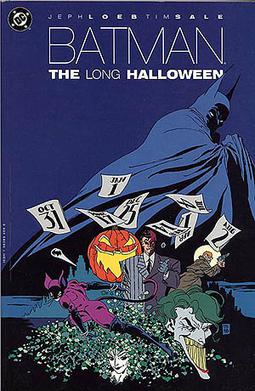
What makes a good whodunit? At the least, strong characters, clues and a clever twist. But also: interesting psychology, defective personalities or madness and multiple points of view, an ominous danger at large, and something that challenges justice itself, provoking us to speculate on wider societal issues or ills or the very human heart itself.
On my recent holiday I finally got to read Batman: The Long Halloween, which provides all of these. Best of all, it has a final chapter that keeps its secrets until the very last pages, as well as managing to subvert not only Bruce Wayne's mindset and mission as the Batman, but also perhaps the way we imagine our lives to be: secure and incorruptible and wholesome, while we set up structures and people as idols we will follow at all costs.
This graphic novel, originally published as a 13-issue comic series in 1996-7, stands by itself, while using some of the characters from Frank Miller's amazing character-piece Batman: Year One, notably the mafia family of the Falcones (with shades of The Godfather). The story is set across a year with each chapter themed after a different holiday, like Valentines Day and Fathers Day and so on. At this point Bruce Wayne is growing into the Batman role and working more closely with the "dream team" Jim Gordon and Harvey Dent, who is the "Apollo" District Attorney and very much the last public light against corruption for Gotham (you remember him from The Dark Knight?). Imagine the public and private pressure setting in as Harvey must find a way to bring down the criminal families, while the Batman tries to solve an increasingly unstoppable series of murders while being led in all the wrong directions but some of his usual enemies: The Scarecrow, the Joker, Poison Ivy.
All of which ends up, I think, brilliantly, making the Batman into a valiant failure. How could he have let the murders keep happening, and why didn't he do more, sooner? Perhaps we should see it the other way: how could one man, limited by his own point of view and frustrated and distracted by his enemies, ever hope to redeem a city anyway? What does he have to lean on after all? The help of a few friends in Gotham? The hope of a better future? His brain, or being able to infiltrate and be there to stop crime at the right time? I think the way the ending comes about and the last words "I believe in Harvey Dent" mirror his own words "I believe in Gotham city" at the start show a world in crisis and a world where individuals act out of their own belief systems, at odds with each other. What a place of despair Gotham would really be - it's a bit like the repeated refrain of the book of Judges "everyone did as they saw fit" and great wickedness reigns because of it (17:6, 19:1, 21:25).
There's more going on here beneath the chaotic criminal goings-on and the beautifully dream-like noir-style of art (by Tim Sale, who drew art for and designed the look of TV series Heroes). This art adds to the whole by detailing the characters' expressions so we can believe in the characters feeling what they are doing - from the desperation of the crime-lords to the toughness of Jim Gordon. They only want to see things through...
For another good Batman story which acts as a whodunit, try Face the Face which is set much later, after Batman has been away from Gotham for a year. He comes back with perhaps a bit more humanity (which was cool to see) as he re-teams with Robin and tries again to work with Harvey Dent to uncover a murderer, but can he trust Harvey?
Showing posts with label crime drama. Show all posts
Wednesday, 28 September 2011
Sunday, 4 July 2010
Mini- review of bestseller The Suspicions of Mr Whicher (2008)
Mr Whicher was a famous detective from the first stock of detectives ever produced, back in London in 1842. This non-fiction book mainly deals with a murder case he investigated, that of young Saville Kent, who was less than four, but it also covers most of his life with fascinating detail, especially the parts about his first successes.
The details bring it alive. For instance, he tricked a crook into handing back a stolen diamond shirt-pin in a bar, by knowing exactly how the crook worked with an accomplice. Another time he and two fellow officers got into a scuffle with some thieves, trying to recover some stolen jewels, and we read that Mr Whicher was set upon by a man with a red hot poker.
The details of the murder of Saville in his own house at Road Hill are shocking and by the end of this well-researched book much has been revealed about the need for morality and love in the household and in the family. Other fascinating themes and questions are raised as well as the whole country became obsessed with the case in the 1860s and were not satisfied when they could not see justice done. So the need for public justice is shown, but so is the foolhardiness of many who had little to do with the case writing to Scotland Yard with their own theories about what was done, and by whom. Even Charles Dickens had a theory!
Finally the question of madness interested a casual fan of classic Gothic/sensation literature like me. It really makes you wonder what madness is. Is it getting things in the wrong perspective, like a sociopath who does not see that a certain human life has value? Is it not having the proper feelings there? Is it doing something horrendous, out of character, or out of spite or anger (yet surely this definition isn't too far from things any of us have done). What is madness and what is just plain evil, after all?
The book, which perhaps could have been shorter, brings out all the ways this case became politically and socially important, and finally the sentence is passed and we know who did the terrible deed. Author Kate Summerscale reminds us in the last few pages that we must not allow the tragic loss of a human life to become lost in the intellectual game of finding out "whodunit", which is a brilliant sentiment to end on, and the whole thing is an illuminating and really interesting read.
Monday, 28 June 2010
American History X
Brutal and horrible, but totally compelling, I wanted to mention this film for a couple of reasons:
1. It's unusual to find a film that deals so convincingly with the human psyche. It shows how one man in American suburbia realises that the militant white power cause he's been living for is foolish and destructive. He sees that the movement has begun to manipulate him, making him a figure to revere because of the two murders he carried out - while he serves a tough prison sentence, alone and friendless.
At the beginning of the story Derek (played brilliantly by Edward Norton) is a neo-Nazi, full of hate, totally unpleasant, power-hungry, manipulative, clever but arrogant, full of testosterone and turning everything into protecting his family from who he sees as the enemy: foreigners and outsiders. But in light of the way he's humiliated in prison (a horrible section) he gets out of that life, which he tells his younger brother Danny is no good for him. He becomes a man determined to change, and to stop Danny following the same rebellious, anti-social path.
Some of the issues this raises are very interesting. For instance - why is it we tend to desire what is best for close family, even if we have given up on ourselves? This rings true.
And it highlights how, without something life-changing snapping us out of it, we tend to believe what is most convenient, what fits with the ideas that have influenced us in the past. This is how prejudices work I think eg. against immigrants. We can become trapped by ideas, which are actually lies, thinking we know all the facts. We weild the "facts" as weapons, or to stir us on.
And such "facts" can be power - a way to put down others and assert oneself or "succeed" in life. Feelings of injustice and resentment find a target. Responsibility is avoided, and so are responsible solutions, as the system is "against us" - let's just take it into our own hands.
The trouble is - when we want to be angry and take things for ourselves: the nonsense "facts" that we want to hear can sound so reasonable. Whether it's anger at local government for making things difficult, or anger at institutions or communities, it can simmer away in us, and we must be aware of this evil in us. It's true what the (supposedly out-of-date) Bible says: the heart is hopelessly corrupt.
2. The focus on inner-city poverty and the lack of opportunities for the poor is interesting too. Despite the bad patterns of family life passed on through the generations, this is a community that will not give up on its characters. And it's refreshing to see this in a film. Especially the bond between the two brothers, where frustration is met with patience, and respect is fostered. Even the teacher, an outsider, Dr Sweeney (a superb performance by Avery Brooks) won't give up on Danny, while Derek talks to his girlfriend (who seems to delight in being near chaos) to try and convince her to leave the movement with him, and others too haven't given up on the loved ones they have lost. Society matters in this movie - life is not throwaway, like the bad guys dying in old James Bond films. People are precious, especially when you don't have much.
The question is what will emerge at the disturbing end of the film? Will the violence cease? What legacy will these two brothers leave on their families, the next genration growing up in the schools, the world around? What lessons will be learnt about the fruitlessness of holding on to a destructive, angry cause?
1. It's unusual to find a film that deals so convincingly with the human psyche. It shows how one man in American suburbia realises that the militant white power cause he's been living for is foolish and destructive. He sees that the movement has begun to manipulate him, making him a figure to revere because of the two murders he carried out - while he serves a tough prison sentence, alone and friendless.
Some of the issues this raises are very interesting. For instance - why is it we tend to desire what is best for close family, even if we have given up on ourselves? This rings true.
And it highlights how, without something life-changing snapping us out of it, we tend to believe what is most convenient, what fits with the ideas that have influenced us in the past. This is how prejudices work I think eg. against immigrants. We can become trapped by ideas, which are actually lies, thinking we know all the facts. We weild the "facts" as weapons, or to stir us on.
And such "facts" can be power - a way to put down others and assert oneself or "succeed" in life. Feelings of injustice and resentment find a target. Responsibility is avoided, and so are responsible solutions, as the system is "against us" - let's just take it into our own hands.
The trouble is - when we want to be angry and take things for ourselves: the nonsense "facts" that we want to hear can sound so reasonable. Whether it's anger at local government for making things difficult, or anger at institutions or communities, it can simmer away in us, and we must be aware of this evil in us. It's true what the (supposedly out-of-date) Bible says: the heart is hopelessly corrupt.
2. The focus on inner-city poverty and the lack of opportunities for the poor is interesting too. Despite the bad patterns of family life passed on through the generations, this is a community that will not give up on its characters. And it's refreshing to see this in a film. Especially the bond between the two brothers, where frustration is met with patience, and respect is fostered. Even the teacher, an outsider, Dr Sweeney (a superb performance by Avery Brooks) won't give up on Danny, while Derek talks to his girlfriend (who seems to delight in being near chaos) to try and convince her to leave the movement with him, and others too haven't given up on the loved ones they have lost. Society matters in this movie - life is not throwaway, like the bad guys dying in old James Bond films. People are precious, especially when you don't have much.
The question is what will emerge at the disturbing end of the film? Will the violence cease? What legacy will these two brothers leave on their families, the next genration growing up in the schools, the world around? What lessons will be learnt about the fruitlessness of holding on to a destructive, angry cause?
Thursday, 27 May 2010
Comics: Daredevil: The Man Without Fear - and the cat burglar with her eyes on the prize
Today I want to mention some great graphic novels I’ve read, such as the first massive Daredevil Omnibus by Alex Maleev and Brian Michael Bendis. (If I know you and you want to borrow this, just ask - you won’t be disappointed.)The first story in the volume, Wake Up, has to have some of the best, most emotional and expressionist comic art I have ever seen, and is very well suited to this interesting mystery about just what a child has witnessed Daredevil doing. It shows up the moral grey areas in Daredevil’s violent war on crime. As for the rest: Bendis takes the well-known rivalry between our vigilante hero and Kingpin to an interesting place, when an ambitious young gangster starts on the scene and orders a hit on both of them, in a classic moment of betrayal. Watching Kingpin being cut down in such an underhanded way is like the people turning on their “Caesar” of crime. Where will it lead?
Daredevil lurches from one crisis to another and his reaction to his law partner Foggy when things start to throw their futures into uncertainty is very memorable. What an excellent piece of character-driven crime fiction this is! Towards the end, when Daredevil faces the new Yakuza, it seems to become more than a book should be, movie-like, yet different to a neatly-tied-up movie, perhaps like a carefully plotted TV series - always building on what has been set up and surprising you by revealing has been going on in the hero’s personal life. There is a further volume by this creative team, so I look forward to getting hold of that one in the future.And now for something stylistically very different to the realism of Daredevil: Selina’s Big Score – This is a great heist story, following all the traditions of that genre, keeping us guessing about whether the criminals will make it out alive. The idea is for Selina Kyle (having a break from being famous burglar Catwoman) has to make some money quickly – and masterminds a plot to steal from Gotham’s gangsters from a train heading in from out of town. Darwyn Cooke, who worked on both the story and the art, shows he can use multiple character narratives well to grab our attention, to show the character’s conflicting desires, and to raise the stakes – they all need this job to come though
– and the tension ratchets up towards the finale. Cooke’s art is at his best here, infusing everything with his unique mood and style – I love it! The story is collected with some of his other comics work in a collection called Batman: Ego and Other Tails – but while Batman: Ego is a fairly interesting look at Bruce Wayne’s war on crime, Selina’s Big Score is better told and paced, and full of energy. So forget Ocean’s Eleven/Twelve/Thirteen and go for something a little more dangerous, but just as colourful and fun.
Monday, 13 July 2009
How Heat (1995) influenced The Dark Knight (2008)
With director Michael Mann’s new film Public Enemies in cinemas, and because of my interest in Batman, here’s a brief introduction to how the latest (and greatest) Batman film picks up on lots of elements from Heat, Mann’s adult crime drama. You can see it even from the DVD back cover of Heat, where we see Al Pacino standing with shotgun ready, resembling a moment where Gary Oldman’s character Lieutenant Gordon heroically faces the Joker. Or try the opening sequence, a carefully orchestrated and clearly shot armed robbery of a delivery van* in broad daylight by a team wearing white hockey masks. The difference is that in The Dark Knight the Joker’s bank robbery (which opens the film) goes perfectly, with no loose ends (if you have seen it you know what I mean) – while the member of the gang in Heat who manages to escape the rest of the gang becomes an important seed of the group’s downfall.
Battling with hearts and minds
Moving towards some of the big themes of the films, both give an account of a struggle between two factions, with high stakes for each side – but ultimately, these are struggles based on principles. In Heat Robert De Niro plays professional criminal Neil McCauley, who goes after big “scores” with his crew, but who becomes conflicted. He insists that he will live a life without ties – where everything and everyone can be left behind in 30 seconds if the “heat” is on to them. Yet while this is the life he has built for himself, and accepted, he starts working towards another one, longing to leave behind all bank “jobs” and escape with Eady. He is finally spotted by Pacino’s Lt Hanna while trying to clear up loose ends, the betrayal of his own principle – in fact it is precisely the feelings of loyalty (and anger) that he imagined he could ignore which make him go back, and stop him cutting loose from the city at the crucial moment. His philosophy would have worked, but was apparently unliveable – he could not leave behind the relationships he started: it would be denying the worth he felt they really had – in a way, denying himself. This poses the interesting question to us: when the pressure is on, what or who really matters to us? What are we willing to make a stand for, even when it makes things messy and difficult to deal with?
Similarly Lt Hanna (McCauley’s nemesis) attempts to manage his own relationships in quite a brutal way, putting his job first (his wife confronts him with this idea that this hunt for prey is the “only thing you’re committed to. The rest is the mess you leave as you pass through”) – but the difference between the two is Hanna’s fierce, unwavering loyalty to his city and his police department, and to capturing the gang.
In The Dark Knight the ideological battle is more sinister. It seems that the Joker, fascinated with the appearance of the hero Batman, is trying to prove that people in general, and even those who consider themselves to be “in the right”, are not really good, and can be turned towards evil if their circumstances change, and they feel betrayed, or afraid, or come under some other kind of stress, such as suffering an unjust loss or trauma. Unnervingly he seems to face us with the question: “what will it take for us?” He seems to prove in the film that people are fragile and that chaos is easily achieved, as reinforced by his final words in the film, to Batman: “You see, madness, as you know, is like gravity – all it takes is a little push!” However the Batman manages to restore order and bring an end to the ongoing terrorism, and it seems that (although he comes close) he does not “break”. He proves to the Joker that it is possible to continue resisting evil (even under great strain) without becoming twisted and evil, like the DA does – although for Batman to do this it comes at great personal cost. It is as if the line that the DA crosses in taking a life makes him irreparable, even irredeemable, whereas Batman can remain heroic because he never succumbs totally and kills.
Defending the city
Heat makes a lot of comparing the lives, quality of relationships and motivations of the LA cops with those of the criminals they are after. Again, heroism comes at a personal cost, which at times must be unbearable for Lt Hanna, whose wife loses patience with him and whose step-daughter suffers too from his absence.
In parts it seems the cops in Heat are trying to defend their city with as much self-sacrifice and obsession as Bruce Wayne shows in the recent Batman films. It’s an all-consuming quest for justice which requires ugly action, tough strategy, careful planning, sleepless days and long nights. In many ways you can understand Heat as a revenge tragedy. The police see it as “You kill our men, you disrespect the law – don’t expect us to hesitate in shooting back and taking you down”. Los Angeles has got to be safe, and dead cops have to be avenged.
As in the comics, Batman is also bound by a code and an absolute commitment to protecting his city. Director Christopher Nolan’s take on the character is that he acts out of a belief in the fact that there are good people in the city, which he can not let be swallowed up and bullied by the criminal element. This was a big theme in Batman Begins** (the first in this revamped series), where a young Bruce had to get to a position in which he could trump the “bullies” by creating his own intimidating presence, thereby using their own weapon against them. He is simultaneously purging the city from the clutches of corruption and ransoming the city for society to be able to function. This is why the Joker’s random destruction is so threatening, totally undermining order and the city’s infrastructure (eg the police, the mayor’s office, high society, the prison system, and memorably, the hospitals).
Bruce dedicates himself to cleaning up the city, carrying on the proud tradition of his parents (like a knight archetype who reveres and continues the work of past martyred saints – it is not too far-fetched to make this the equivalent of a holy
cause for him); and in The Dark Knight, he enlists other “knights of the realm” to stand guard alongside him, deepening his partnership with Gordon and the police force, utilising big business, even the city hall. While The Dark Knight seems to cover a lot of intellectual and mythological angles on this battle against corruption, Heat is a more personal tale, tugging at our emotions as we see the way circumstances, words and actions bring tension between families, and hurt partners. The gang gamble on making some big scores, to support their chosen lives, but the promises they make and break are significant beats of the story – and the horrific final shootout has reverberations on all those close to McCauley’s crew, and beyond. I salute the writers and directors for making such fascinating worlds to lose ourselves in, and whose strong characters create gripping ideological (and physical) struggles in each film.
(NB: Heat clocks in at 164 mins, so it feels like quite a long watch. If you like it, Al Pacino is also interesting to watch in crime drama Carlito’s Way (1993), a film which is slow-burning, leading to a thrilling 20-25 minutes finale section, as Carlito makes his run for freedom from his past gangster life, similar to De Niro’s final run in Heat. I won’t recommend the film wholeheartedly though due to gratuitous sex and nudity, just to let you know.)
~~~~~~~~~~~~~
*The Dark Knight also has an armoured delivery van which is attacked as the focus of one of the Joker’s crimes, and so the similarities continue! British director Christopher Nolan acknowledges that Heat influenced him, and it probably was the reason he went for the kind of freeway landscapes he did for the big chase scene, to show a similar kind of world: a heavily built-up, industrial city.
Other similarities between the two films: Incredibly strong casts, and both films have brilliant sound, building tension through it using some strikingly similar long drone sounds.
**In Batman Begins there is a scene which reminds us how utterly irrational and evil extremist terrorist groups can be. While razing Wayne Manor to the ground, villain Ra’s reveals his motivation – a plot to burn the city down, as was done in the days of ancient conquest – all in order to produce a “better” world afterwards. I love how the language sounds kind of earnest and rational, but when you think about what they are saying it is utterly evil and mad! This reminds us that all evil is ultimately irrational, coming out of a faulty, broken understanding of the world and ourselves, and we can’t ultimately explain it away, or excuse it: it just is wrong.
Subscribe to:
Posts (Atom)