Sunday, 25 September 2011

Metronomy - the beat of the wierd

If I've given you a lift in my car lately, chances are you might have heard some of the new Metronomy album I've been playing a lot: The English Riveria.

Typically known for their remixes of other work (eg Goldfrapp's Happiness) this seems to be a kind of breakthrough album for the odd outfit, who use mostly electronic instruments and percussion but also use voice and other stuff (nice bit of flute near the end of the album). 

I like the quirkiness and catchiness of the beat, and the slightly chaotic way of mixing all this with the lyrics and riffs and short keyboard melodies. It's superior synth nonsense that achieves something more - try tracks like the well-balanced "The Bay" the addictive "The Look" and the pop-like "Everything Goes My Way". Then delve into the rest of the album and be surprised by the cool restraint of "Loving Arm" or the expanding upbeat guitar/synth sound of "Corinne" that slowly fills out the room with the chorus (of sorts): "I got my heart tied up, I got my heart in a bind, she just wants to dance all the time".

Recommended as something a bit different to everyday pop.

Picture by Платонова Алина (http://gete-ap.livejournal.com/62796.html) [CC-BY-SA-3.0 (www.creativecommons.org/licenses/by-sa/3.0) or GFDL (www.gnu.org/copyleft/fdl.html)], via Wikimedia Commons

The Sunflower


A poem I wrote a few months ago:

The Sunflower

We hold up and gaze at
The head as big as our own,
It scours the earth below,
Magnificent;
We cradle it in child’s arms.

Let’s prise out seeds
Over the earth to watch
And listen to their flat sides bed down
In secret;
A molten dew-shower.

Here lies our treasure,
X marks the spot,
Let the place not be forgot.

Dreamily it asks why
We cut off its head –
“we were young”
We stammer,
“You seemed dead”;
We saw the plunder,
The wealth we hoped for;
We went for broke.

© Richard Townrow


Saturday, 27 August 2011

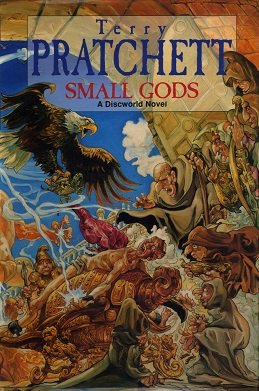
Sparrows, living and reading Small Gods

In the thirteenth and very funny Discworld novel Small Gods, Om says the difference between being a small god and human is that humans are uncertain about what lies beyond death, but gods really know that when they come to the end of their lives/reigns there is nothing more for them, that is the end of their real existence - all that's left is longing for what was. At the end of their magic and belief-fuelled "lives", small gods go into darkness after just a moment of "warmth and light", like a sparrow that flies through a room and out into the black night - and he asks "can't you imagine what it's like to be that sparrow, and know about the darkness? To know that afterwards there will be nothing to remember, ever, except that one moment of the light?" (p277). Enter the debate about whether waiting for death is torture and whether the end is really the end.

In Pratchett's fantasy world gods exist if they have believers, otherwise they fade to barely a whisper, their minds fractured, barely keeping themselves together. Some start there but manage to work their way up to real power through accumulating believers. This means that they have to work out how to manipulate people into following them, which doesn't bode well for the cause of truth, love and justice. Indeed through the course of Small Gods it's a human who teaches the small god Om ethics, a way of leading a people to treat others more fairly and with respect.

Interestingly as with a lot of Pratchett books, the stupidity of humanity is brought out here, because despite the ethical way being the one way free of bloodshed, the people still want war, because of honour, duty, hurt pride, impatient zeal for change, and revenge. Pratchett shows how lucky we have to be for good leadership to win out, when people's hearts are bent like this, and when people are preoccupied by things that don't really matter. The small god points out that people will believe anything, even in the power of an army or god, or in the revolutionary spirit or human philosophy, if it suits them - if they think it will allow them to gain something in the world, if it promises them something they feel they need. Both the religious who hold on to a system and the militant atheists have ambitions and values at fault in this in the book - rushing into their cause without thinking of the consequences in terms of their responsibilities to seek peace for their fellow man. Knowledge is co-opted into making machinery of war. Only one or two characters have the eyes to see the folly of the people.


The hypocrisy of the harsh religious system in Omnia is plain and some are brimming to just escape from the rules, while others find meaning in enforcing them. But when it comes down to it, what do the religious sacrifices they make or the battles fought in the name of honour or revenge gain them?* If this is a kind of bargaining with the gods, it’s a poor deal. I think we need this sort of clarity in thinking about why we do the things we do. Our culture is tied up in pursuits, whether of influence, reputation on- or offline, expertise, deeper relational links, a hoard of commercial products we feel we need, the avoidance of any pain or suffering, the best holidays, and constructed meaning in other ways. What does all of this gain us in the long run? Is the key not to obsess and just find balance? And what does it gain us in the face of death and beyond that eternity? When we realise we are going somewhere next and that we can't take anything with us, why do we get so caught up in so many pursuits which seemingly can continue all our lives?
But going back to the way in this book a "god" can fear the absolution of a pseudo-non-existence: It's very interesting how this is portrayed as happening to one small god who is found as a bodyless voice in the desert that has been roaming there for years and can't even remember it's name. Even Om is lucky to remember who he is after amusingly getting trapped in the body of a tortoise.

If our ultimate destination is to be a kind of wimpy non-physical confused and hopeless half-life, I'd hate it too. Maybe this is what people fear most today: being insignificant, being unfulfilled in this life and withering away. They want to live fully and die young and happy. I can relate to this. But as a Christian I want to challenge the assumptions here - I want to say that living into old age, disability, or insignificance in the eyes of the world and living even in weakness and illness can be real living if it's done in relationship with God. If real love is experienced. If you are getting to know him and trust him better, if you are awaiting his promise to bring a kingdom where you can fully be with him, if you see his goodness no matter your situation, weakness can be a time of blessing. Furthermore if we have a hope beyond this life in the one man who came back from death, Jesus-Christ, the God-man, we do not have to have a fear of death and can get on with living for what really matters.

All in all, a thought-provoking entry into the Discworld series that I could relate to a lot. People are cowardly and create systems that don't work, and forget the value of true liberties in society. Luckily our God is large and will never lose the plot. He cares about us more than many sparrows. Like Om he listens to us, but unlike Om he loves us and knows what is good, and will never get trapped in the body of a tortoise.

--------
*You wonder if there was this kind of hotchpotch of mixed motives in the recent march on Tripoli. There must be stories to be found there both of altruism and, sadly, brutish steamrolling over the ones in the way.

Cover image uploaded from Wikipedia to illustrate the book I'm discussing. It's originally derived from a digital capture (photo/scan) of the book cover (creator of this digital version is irrelevant as the copyright in all equivalent images is still held by the same party). Copyright held by the publisher or the artist. Claimed as fair use regardless.

Monday, 22 August 2011

Summer 2011 sketches and photos

There's been so much to enjoy this summer! Highlights have been: a holiday in Deal, seeing some action movies with friends, eating out (tapas) with some international students and attempting to teach them English phrases, catching up with my older brother and school-friends, and going to some great weddings, which have felt like big happy celebrations.

With all this going on, it's no wonder this blog has been looking a little neglected. Please check out this small collection of photos and sketches I've produced and stay tuned for proper updates.


Friday, 3 June 2011

Thor & debts to one another in a kingdom

Personally I found X-men: First Class a slightly more polished and enjoyable film, and an absolute blast, with good new characters and 1960s spy-film influenced plot, and action beating X2 – but I think Thor was more ambitious, and despite being a tad too silly and “summer blockbuster” in the bits set on Earth, it had more interesting themes. May his return in the Avengers film next year continue the fun!

So here's my take on some of the themes of Thor:

Often in action films you get a kind of brother-in-arms camaraderie, but in Thor comics there is a sense that the gods of Asgard are connected. Each has their role and without one of them fulfilling it they are lacking. Thor has a responsibility to lead his people well – and they have a responsibility to be the noble people they are meant to be in service of their brother-in-arms, the mighty Odin-son Thor.

Which is why a recent Thor story got my attention.* It reminds us of how people can be trapped by their own desires and pulled away from what is really good for them. In it Loki skilfully manipulates Thor, managing to shame him so he is not worthy to be seen and followed as leader. Unlike in the film, Odin is no longer about, and the throne is taken by Balder, who, with Loki at his ear, makes the decision to find a new home for the Asgardians. He believes the restlessness of the fearless Asgardians is due to them being trapped in their re-born realm which is floating in the sky above earth, and that they should move to the wild land of mountains and forests that belongs to Marvel arch-villain, Doctor Doom.

It’s a classic case of trying to solve a correctly identified problem with an answer that isn’t going to fit. This race of people live larger than life and have a real longing for the open air and the pursuit of games and hunting. They want to live life! But living under a wise and good King is the key to their security and hope and anything less is a compromise. Yes, their king Thor should have heeded their restlessness and provided for them – that would have been wise. But to have been corrupted by Loki and end up being led into a land ruled with an iron fist by Doom is the worst kind of deception and is likely to lead to needless difficulties or war. It certainly divides them against their King. And it’s a knee-jerk response to the deeper problem of wanting Asgard and life back in its fuller glory. It’s going after a temporary solution that isn’t really one at all.


I love how the corruption is depicted as working – very subtly. Loki, manages to frame truth in a way that accuses Thor stopping him in his tracks and making others lose confidence in him. (Doesn’t evil tend to do this? Evil takes our worst actions and hits us with it – and then it isolates us if it can.) Loki’s apparent honesty in exposing Thor leads to a loss of discernment as people begin to trust the perverted power-mad Loki. Yes, Thor has failed them, but the worst result of this is them sitting under the wrong king. They have lost their purpose and think it is to be found solely in the exciting new realm Balder offers them. May we not lose sight of how we owe each other to act rightly to build each other up in our purposes in life. It’s how we were created – to live life to the full**, in freedom, and “to act justly, to love mercy, and to walk humbly with our God” (Micah 6:8).

A couple more points on the film before I sign off. I generally liked the way Thor interacted with humanity and the idea of him aspiring to be something more, and inspiring others, was pretty neat - and, in a way, so was the linking of ideas about there being amazing truth out there to be discovered with the "gods". The spin on Loki and his relationship to the wise King Odin was very interesting, and challenges us – what would you do if suddenly lots of power was thrust upon you in your darkest hour? Would you be responsible and shoulder the responsibility well or try to cut others out or try to impress others? How do you react to how people judge you – are you paranoid, getting hurt easily when people fail you, taking the love you can get and hiding away, or do you listen to others and love others generously, from a place of gratefulness at all you have?


*Thor 601 “Defining Moments” written by J. Michael Straczynski
**See, for example, John chapter 7 v37-8, chapter 8 v12, 31-2, and chapter 15 v11.

Check back for more on comics and books later in the month.

Saturday, 7 May 2011

The Dark Knight Rises - will it include a Lazarus pit?

If you haven't heard already, The Dark Knight Rises (the next Batman flick) is filming and all over the internet you can see a leaked photo of some green liquid on one of the sets. This isn't pointless slime - it's bright green so it can be picked up from footage easily and altered or animated somehow. So what?

It suggests a Lazarus pit* could be involved. If you don't know the comics the Lazarus pits of Ra's Al Ghul are able to sustain/strengthen life or even bring someone back from death. It also seems to bring on a form of madness, although this isn't totally consistent in the comics.

The fun of having this supernatural thing happening in Batman's adventures was knowing this just does not fit with his view of the world. He works all the angles and needs to know how all the mechanisms work. But what of souls? And if they come back into lifeless bodies, where did they go in the meantime - what science could he use to deduce this? He can investigate but not get to the bottom of it: in the end it is more that he has to accept it.**

Where could director Christopher Nolan and his increasingly impressive cast take this? Here are a few possibilities:
1) Surely this means that Ra's Al Ghul is returning - or possibly a successor like his daughter Talia, who was unseen in Batman Begins. The ninjas Bruce faced in his mansion were from a long line, and that line is bound to have continued somewhere. And Ra's could be resurrected through use of the pit, or perhaps Batman will stop him just in time?

2) It's not very likely, but Bruce and Gordon could try and resurrect Harvey Dent (aka Two-Face) in one of the pits to try to re-create the white knight who fell in The Dark Knight.
3) The new film is called The Dark Knight Rises - so could Batmen die and someone resurrect him in one of the pits? This would fit with the previous film's theme of the city of Gotham needing someone like the Dark Knight, and be a nice counterpoint to the start of the film which I imagine will be about the police and/or army hunting Batman for the murders everyone thinks he committed in The Dark Knight. Could be quite cool, and a related idea was used in the recent comic Batman and Robin issue 7 and 8: Blackest Knight, with the question being - is the Batman who emerges from the pit going to be the right one, and in his right mind? (Batman and Robin stars a new Batman, as Bruce Wayne apparently died in the comics recently***)

4) It could be a new evil using the pit endlessly to stay alive. The evil has surely got to be something that affects the whole city, like the Joker did, and a villain who seems to have power over death could inspire horror and even submission in the populace.

On a related note, the villian Bane is set to be in new movie I hear - and I hope this is done well. In the comics he is often used very poorly and has little or no character. He is just famous for a dark epic story from the early nineties where he broke Batman's back and totally defeated him.... wonder if this could be where the film goes? 

Either way I'm sure the writers will love to play with the idea of questioning whether it's possible to rise from death and live in a kind of mad power-mad immortality that many villains in comics seem to want to achieve. What messages might come through about what real living is, I wonder? Or about relinquishing power and serving a city of other people? Furthermore there was always something Satanic about the pits, which are in the belly of the earth and perpetuate the life of a centuries-old manipulater and murderer whose legacy is a cult of warriors who obey his every word. Perhaps the film will bring out the horror of this monstrous and unnatural battle for supremacy over the world from below.

With Marvel taking another step in the right direction with Thor and then Thor, Iron Man and Hulk joining the Avengers film next year****, Batman faces stiff competition in the superhero movie department. But I have confidence The Dark Knight Rises will prove to be more thought-provoking and mature than the others (much as I like them)!


*Presumably named after the biblical Lazarus, an ordinary man Jesus publically raised from death.
**Over the years Batman has been forced to accept there are some supernatural things in the universe, although even in Neil Gaiman's excellent recent story "Whatever happened to the caped crusader?" Batman states that he does not believe in a god, and the story still emphasises his own role in carving his own meaning in his physical existence - while portraying him as a kind of unstoppable force against evil in an eternal battle against evil (Yes, wierd huh?)
***I'm quite behind with Batman, as I have a pile of UK-produced Batman Legends comics to read, and the UK comics are way behind the US ones. The death of Batman is shown within Final Crisis, which you should read alongside the main Batman storyline right through from Batman and Son to the Black Casebook and Batman RIP.
****Directed by Joss Whedon, creator of Buffy, Firefly and Serenity and writer of the first four volumes of Astonishing X-men!

Friday, 1 April 2011

Hooray for trusting in the cross

Friends, hear these brilliant words, which my soul also needs to hear.

In the run-up to this passage John Stott has been talking about wrong ways to approach hard times and God, by self-accusing, self-pitying or self-asserting. But then he starts talking about the best way of all – to see Him afresh spiritually, and trust in Him:

If it was reasonable for Job to trust in the God whose wisdom and power have been revealed in creation, how much more reasonable is it for us to trust the God whose love and justice have been revealed in the cross? The reasonableness of trust lies in the known trustworthiness of its object. And no one is more trustworthy than the God of the cross. The cross does not solve the problem of suffering, but it gives us the right perspective from which to view it.

We need to learn to climb the hill called Calvary and from that vantage point to survey all life’s tragedies. Since God has demonstrated his holy love in a historical event (the cross), no other historical event (whether personal or global) can override or disprove it. 
from Through the Bible Through the Year, p.88

Praise God for the truth of these words!

Thursday, 24 March 2011

New Word Alive is nearly here.....

On a completely different subject, how shall I blog about New Word Alive this year? I don't think I will be blogging there (although I could tweet there), but I will update this site when I get back.

I've previously tried video interviews - shall I do more of these, and see if I can catch one of the speakers/some of the punters? Shall I try something creative and new? What do you want to hear about? I can't promise too much, but let me know!

Specifically what would you ask the speakers? It looks as though we have prominent Nigerian, English and Australians speaking this year. And of course it's always good to pick the brains of someone as God-happy as Mike Reeves (UCCF theology guy), who'll be there as usual.

Looking forward to seeing you there, if you are planning to go!

Tuesday, 22 March 2011

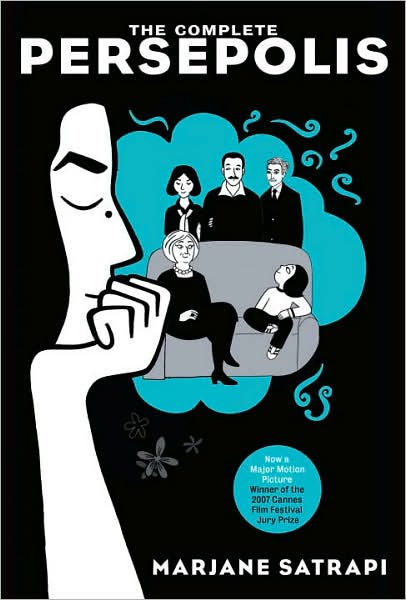
Graphic novel review: Persepolis I

A couple of months ago I had the chance to read part one of “Persepolis” an autobiographical tale of Marjane Satrapi growing up in Iran as a girl and a young teenager. It's worth a read, as we consider the price of freedom for the Libyans and others in the Middle East. Marjane's unique upbringing was a strange learning experience for a young girl and she clearly has many lively memories of her parents talking enthusiastically of “revolution” late into the night, and taking an active part in protests in the late 1970s. The true story is portrayed in this graphic novel with a style that exudes charm and manages to capture through stark black and white pictures some of the emotions of frustration, resolute fervour and desperate loss.

I’m not good with the facts of history, but I love details that bring home what was happening. Marjane remembers what she was doing the day the neighbouring family’s house was bombed during the war with Iraq which began in 1980. She tells how she rushed home fearing the worst, and managed to glimpse a painful sign that her neighbours had been buried when the house came down. It’s moving to think of this really happening to such an ordinary family.

Interestingly we are also introduced to those figures Marjane looked up to as a girl, some imprisoned for many years because of their outspoken views and the longings of people of shrewd minds and hospitable natures as they longed for an end to political injustice. Others with less courage or less wisdom are shown to be inconsistent in their views, and stirred up by a crowd – we get a realistic view of human nature here.

As Marjane tries to comprehend things like the torture of Communists and the changing regimes, she aspires to be a revolutionary herself and imagines herself debating these things with both God and Karl Marx in some light-hearted dream-like sections. Ultimately she feels that the big-bearded God of her dreams is no use to her cause, or perhaps he is supposed to be impotent in her view, an imaginary being made up by children. Either way, she moves on from him fairly quickly.*

She also shows us what it was like to grow up as a child in those times, and the fun and hurt caused between classmates as they discussed or acted out their parent’s differences (somewhat like the children in The Book Thief). The influence of the West on Satrapi is evident, leading her to rebel – although maybe this was more to do with her sharp mind and sense of passionate outrage at what was happening. One amusing section tells of how she was caught by local women wearing a Michael Jackson badge she’d acquired from the black market, and how she lied that the badge showed Malcolm X (MJ was still black then), an important “historical figure” – and they believed her! Another time her parents managed to bring back some trendy posters from (I think) Turkey, by sewing them into the back of a coat.

The obvious love in the family also shines through as they seek to bring up their girl as best they can – eventually sending her away from the country, which as you will have gathered was going through some worrying changes. The glimpse we get here is not only a good mix of the optimism of childhood and the down-to-earth facts of what was happening, it is also a refreshingly individual personal history, where the price of living for one’s conscience and against the current regime is clear.

-----
* As an aside, I hope the way I live and work and stand for causes and pray and trust in God has the opposite effect – that people do not dismiss him as unnecessary, but see the true God of reality as the means by which it is possible to fully and rightly and passionately engage with all the rest of life. 

Click here to find a list of more graphic novels/comics I recommend.

Saturday, 12 March 2011

Graphic novel review: Usagi Hojimbo ("rabbit samurai") vol 1

It’s rare to find a series of stories which manages to capture your imagination, stories that seem fresh even while working within a genre that has definite traditions, stories whose range of characters show a breadth and colour that seems to cover several levels of society. I’m happy to say that this first collection of stories about the lone wandering samurai called Miyamoto Usagi pulls off these feats with a certain irresistible charm.

OK, so the samurai Usagi is drawn as a rabbit, and there are plenty of other creatures around – but this is isn’t a jokey book and fight-scenes are action-packed and deadly. The stories in the first volume "Ronin" are interesting in their variety, from epic quests as Usagi defends the vulnerable people he meets on the road, to a memorable couple of encounters with a mercenary (a rhino) and less-content packed tales of Usagi meeting people, for instance when he is attacked by a brash and arrogant gang at a local place to eat and drink. (Amusingly, Usagi calmly finishes eating his meal while the intruders have turn everything upside-down except his table. When they insult him personally, he takes this as his cue to show them a lesson. Can’t fault his manners, I suppose.)

We come to understand the precarious nature of local politics in the 17th century Japan setting, as Usagi comes across outcast governors and one nefarious villain (cue cackling). One beautifully-formed story shows Usagi making a pilgrimage to his home town – and it shows us how we can still be attached to something or someone we thought we’d left behind. The author deserves credit for including sneaky moles in this tale as well whose deadly ninja training means they can appear out of nowhere by burying through the earth in huge numbers. The series usually has quite a serious and reflective tone, but the “ninja moles” show that author/artist Stan Akai can have some fun!

Finally, the art is quite detailed, showing some influence of Japanese manga, films and history. This Eisner-award winning series which has now been going since 1987 has drawn attention internationally and Empire magazine has named Usagi as the thirty-first greatest comic book character (see the list here) - it’s not hard to see why.

Click here to find a list of graphic novels/comics I recommend - or check back next week for my thoughts on an autobiographical graphic novel about Iran which was published in France - intriguing, no?